ScaleMoGen: Autoregressive Next-Scale Prediction for Human Motion Generation
Accepted to ECCV 2026
1. Text-to-Motion Generation
1.1. Motion Generation via Next-Scale Token Map Prediction
Given a prompt $c$, we autoregressively predict the next-scale token maps $\{q^v\}_{v=0}^{V}$ conditioned on accumulated coarser-scale token maps. Note that the 2D skeletal-temporal token maps are flattened into 1D for ease of visualization.
1.2. Motion Generation Gallery
We show two input prompts rewritten into expressive text descriptions (via an LLM), which are then used to generate corresponding motion results. Our method generates high-fidelity motion from expressive text descriptions
"A person is bowing politely."
The person aligns both feet together and straightens posture before bending smoothly forward from the hips. Hands remain at the sides while the back remains straight. After a short pause, they rise again with controlled motion, reestablishing upright balance and respectful demeanor.
"A person is mimicking a slow zombie walk."
The person shuffles forward with slow, stiff movements typical of a zombie walk. Feet drag lightly, knees slightly bent, and arms reach out with elbows locked and fingers splayed. The torso leans forward with a slight wobble, and the head tilts awkwardly to one side, emphasizing an eerie, unnatural gait.
"A person is running joyfully."
The person accelerates into a light run, taking buoyant strides with arms swinging actively. The torso leans slightly forward, head lifted, and each step shows relaxed rhythm. Occasionally they hop or extend their stride playfully, giving the sense of freedom and delight through dynamic, flowing motion.
"A person walks and turns right."
The person begins in a relaxed standing position. They start walking forward, smoothly turning their head to the right. As they continue moving, they gently change direction by turning their entire body to the right, maintaining a steady pace.
1.3. Comparisons to Previous Works
The person adopts a defensive stance, arms up guarding the head. They rapidly lean back and duck to the side as if dodging punches. Their knees bend for agility, feet shuffle quickly to maintain position. After each dodge, they reset their stance, staying alert and ready for another incoming strike.
The person strums an invisible guitar with vigorous hand movements. Their right hand mimics fast strumming motions while the left hand presses imaginary strings on the fretboard. They lean forward slightly, shifting weight between feet with a rhythmic bounce, expressing excitement and musical engagement.
The person sits or stands and mimics rowing a boat, grasping an imaginary oar with both hands. They perform slow, controlled strokes, pulling back with their arms while leaning torso backward, then pushing forward while leaning torso slightly forward. Legs and feet shift subtly to stabilize each stroke in a rhythmic, flowing motion.
The person bends forward with one knee slightly bent and one foot in front . Both hands move quickly and precisely near the shoe area, looping and pulling imaginary laces in alternating patterns. The torso shifts slightly for balance, then the person straightens up smoothly and adjusts stance before relaxing arms by their sides.
2. Zero-Shot Text-Driven Motion Editing
2.1. Motion Editing Overview
Starting from the source prompt $c_s$, we autoregressively generate the source token maps $\{q_s^v\}_{v=0}^{V}$. With additional target prompt $c_t$ with a source-token preservation mask $\{\mathcal{M}^v\}_{v=0}^{V}$, we predict edited token maps $q'^{(v)}_t$ conditioned on the remaining source motion context and $c_t$. The target token maps $\{q_t^v\}_{v=0}^{V}$ are generated by blending the source token maps $q_s^v$ with the predicted token maps $q'^{(v)}_t$.
2.2. Motion Editing Gallery
We show the original source motion corresponding to the source text and edit prompt, along with its edited motion. Our method supports a variety of editing operations, including semantic alterations, joint-level modifications, and temporal changes.
The person walks forward at a relaxed pace with an upright posture. Their arms swing naturally at their sides in opposition to the legs. The steps are even and steady, with a smooth heel-to-toe motion. The head faces forward, and the torso remains stable throughout the walk.
The person walks forward at a relaxed pace with an upright posture. Their arms lift upward away from the sides, raising the hands to about shoulder height or higher. The steps are even and steady, with a smooth heel-to-toe motion. The head faces forward, and the torso remains stable throughout the walk.
The person walks forward at a steady pace with arms swinging naturally at the sides. Both legs move evenly with a smooth heel-to-toe motion, and the torso remains upright and stable throughout.
The person walks forward at a steady pace with arms swinging naturally at the sides. The right leg moves with a heavy limp, landing with less weight and a shortened stride, while the left leg carries more of the body's load. The torso sways gently to the left with each step to compensate.
The person walks forward steadily in a relaxed pace, pauses in the middle, stands still briefly, then resumes walking forward at the same steady pace.
The person walks forward steadily in a relaxed pace, then bends the knees and lowers into a squat position midway, rises back upright, and resumes walking forward at the same steady pace.
The person stands in a fighting stance and throws a quick jab forward with the left fist, fully extending the left arm, then immediately follows with a straight cross punch with the right fist, extending the right arm forward with more power. Both fists then retract back to guard position.
The person stands in a fighting stance and throws a quick jab forward with the right fist, fully extending the right arm, then immediately follows with a straight cross punch with the left fist, extending the left arm forward with more power. Both fists then retract back to guard position.
3. Multi-Scale Skeletal-Temporal Token Map
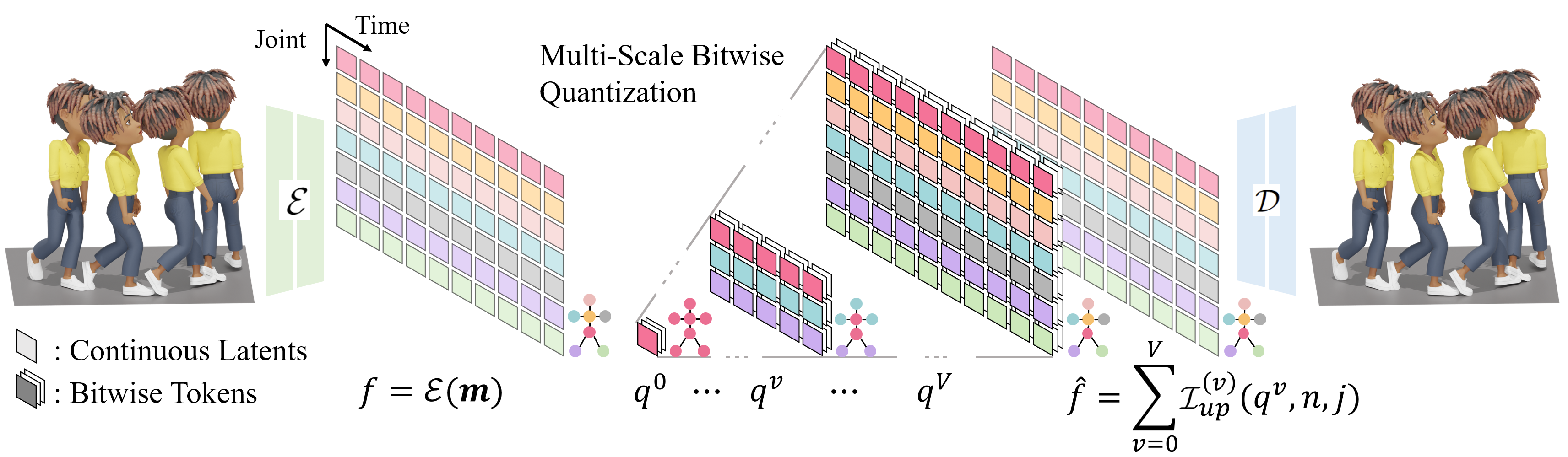
Given an input motion sequence $\mathbf{m}$, the encoder $\mathcal{E}$ maps it to a continuous skeletal-temporal latent grid $f$. The latent is decomposed into a hierarchy of residual components $\{q^v\}_{v=0}^V$ via binary multi-scale residual quantization, where each scale has its own temporal resolution and skeletal partition. The quantized residuals are then upsampled and accumulated to form the reconstructed latent $\hat{f}$, which the decoder $\mathcal{D}$ converts back into a full-resolution motion sequence.
| $\sum_{v=0}^{\mathbf{2}}\mathcal{I}_{up}^{(v)} \left(
q^v,n,j
\right)$ (Scale 3 / 11) |
$\sum_{v=0}^{\mathbf{5}}\mathcal{I}_{up}^{(v)} \left(
q^v,n,j
\right)$ (Scale 6 / 11) |
$\sum_{v=0}^{\mathbf{8}}\mathcal{I}_{up}^{(v)} \left(
q^v,n,j
\right)$ (Scale 9 / 11) |
$\sum_{v=0}^{\mathbf{10}}\mathcal{I}_{up}^{(v)} \left(
q^v,n,j
\right)$ (Full Scale) |
To understand our skeletal-temporal, multi-scale motion representation, we visualize the
step-by-step reconstruction of motions by progressively accumulating token maps across the skeletal-temporal
hierarchy.
In the earlier, coarse-level token maps, the motions of paired limbs—such as both arms or both legs—are
grouped and encoded into shared representations.
As we process rightward towards finer scales, the token maps recursively split according to our
predefined skeletal hierarchy.
Consequently, the
coarse-scale token maps capture global semantic movements,
which gradually disentangle into
highly articulated dynamics
for individual joints at
finer scales.
This hierarchical progression restores the full realism and fine-grained details of the
original motion (the rightmost character).
4. Citation
If you find our work useful, please consider citing:
@misc{hwang2026scalemogenautoregressivenextscaleprediction,
      title={ScaleMoGen: Autoregressive Next-Scale Prediction for Human Motion Generation},
      author={Inwoo Hwang and Hojun Jang and Bing Zhou and Jian Wang and Young Min Kim and Chuan Guo},
      year={2026},
      eprint={2605.11704},
      archivePrefix={arXiv},
      primaryClass={cs.CV},
      url={https://arxiv.org/abs/2605.11704},
}